
Seven days is the shortest standard timeframe for the Lemosho climb, while an eighth day allows more time for acclimatization. A Lemosho Route climb over 7 days takes you from the western side of Kilimanjaro to Uhuru Peak and back down the mountain, with long walking days and a demanding summit push.
It makes sense to focus on the schedule as well as the scenery: the number of days shapes your pace, time to adjust to altitude, and the services arranged for the trek. This guide explains what affects the cost, how the seven-day option compares with an eight-day acclimatization schedule, and what to look for in the trekking package, so you can plan with a clear understanding of the journey.
Key Takeaways
- Understand how the route’s distance, elevation gain, and summit-day hike shape the overall trek.
- Weigh the tighter seven-day schedule against the extra acclimatization time of an eight-day itinerary.
- Know which accommodation and trek arrangements to look for when reviewing what a package includes.
- See how sustained walking and altitude affect preparation, and what kind of fitness the climb calls for.
How Long Does it Take to Climb Kilimanjaro Using the Lemosho Route?
Plan for seven days on the mountain, with a longer summit push and a final descent. The itinerary crosses rainforest, high-altitude camps and open terrain before reaching Uhuru Peak, Africa’s highest point at 5,895 metres.
Route Distance and Elevation Gain
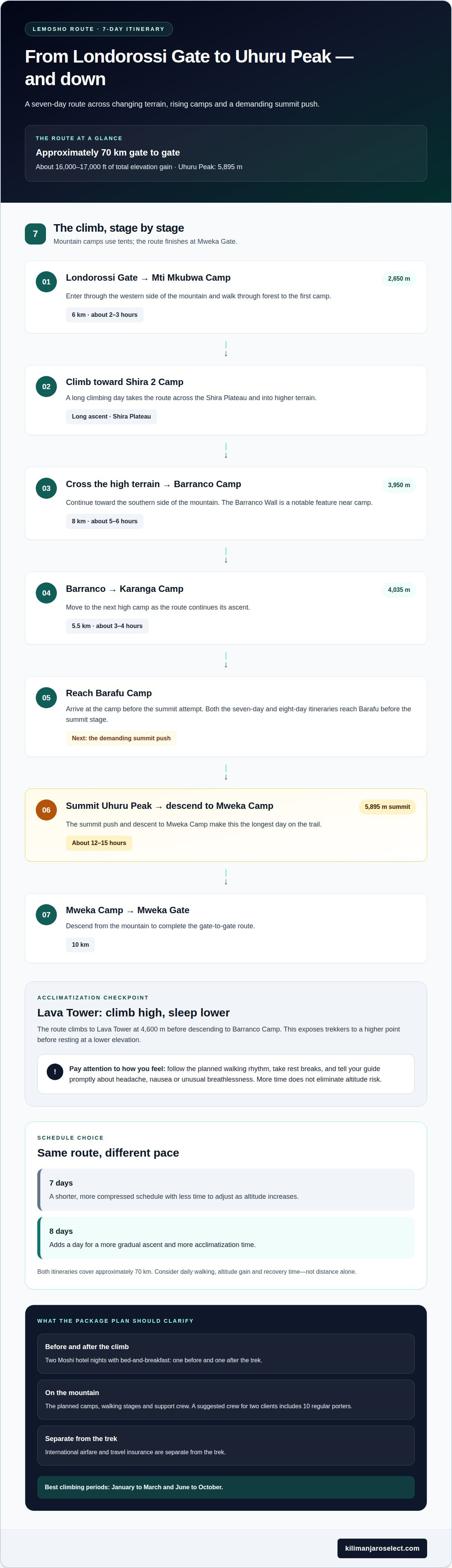
The Lemosho Route covers approximately 70 km from gate to gate, with a total elevation gain of about 16,000 to 17,000 feet. That distance includes the approach from Londorossi Gate, the ascent to the summit and the descent to Mweka Gate. The route’s total distance and elevation gain help show why daily walking time and recovery matter, not just the summit height.
On day one, the 6 km walk from Londorossi Gate reaches Mti Mkubwa Camp. The route then crosses the Shira Plateau and continues toward the southern side of the mountain. Near Barranco Camp, the Barranco Wall is a notable part of the trek. The descent finishes at Mweka Gate after an overnight stop at Mweka Camp.
Daily Trekking Times and Camps
The first camp, Mti Mkubwa, sits at 2,650 m; day one’s walk takes about 2-3 hours. Day two is a long climb toward Shira 2 Camp. Day three covers 8 km to Barranco Camp, taking 5-6 hours. Barranco stands at 3,950 m, while Karanga Camp is at 4,035 m.
Day four’s 5.5 km walk from Barranco to Karanga takes 3-4 hours. On day five, the route reaches Barafu Camp. The summit day and descent to Mweka Camp take about 12-15 hours; day seven covers 10 km from Mweka Camp to Mweka Gate. Mountain camps use tents, while the itinerary includes two hotel nights around the trek. January to March and June to October are the best climbing periods.
Seven-day versus eight-day acclimatization
Both itineraries follow the Lemosho Route, but the eight-day option allows more time for acclimatization. Its extra day makes the ascent less compressed as the trail climbs Mount Kilimanjaro.
Acclimatization by Trip Duration
The seven-day itinerary is shorter, leaving less time to adjust as the altitude increases. The eight-day schedule adds a day for a more gradual ascent. Choose by weighing your available time against the benefit of a slower pace. The extra day creates more room in the itinerary instead of fitting the route stages into fewer days.
Both itineraries pass through changing landscapes, from forest near Londorossi Gate to higher camps. Key stages include the Shira Plateau, Lava Tower and Barranco, each bringing a change in elevation and terrain.
Altitude Safety and Acclimatization
Altitude acclimatization is the body’s gradual adjustment to thinner air as the trail gains height. On the route, the itinerary climbs to Lava Tower at 4,600 m before descending to Barranco Camp. This “climb high, sleep lower” pattern exposes trekkers to a higher point before the night’s rest at a lower elevation.
An eight-day itinerary allows more time for adjustment, but pace matters too. Follow the planned walking rhythm, take rest breaks and tell your guide promptly about symptoms such as headache, nausea or unusual breathlessness. These steps support careful altitude management, but a longer itinerary does not eliminate altitude risk.
Route Length and Acclimatization
Lemosho covers approximately 70 km from gate to gate, so the choice is not simply about shortening the distance. A seven-day plan compresses that journey into fewer days, while an eight-day plan spreads the route across more time. Consider how daily walking and altitude gain fit your available recovery time, rather than judging the schedule by distance alone.
If additional acclimatization time is your priority, explore the eight-day Lemosho itinerary as the longer schedule option. Both plans reach Barafu before the summit attempt; the key difference is how much time the itinerary gives you before that demanding stage.
Included trekking package services
A Lemosho trekking package should explain what is arranged before, during and after the climb. Look beyond the route name: accommodation, mountain crew and the day-by-day itinerary determine the practical support included.
The package includes two bed-and-breakfast nights around the trek, before and after the climb. These stays provide a place to rest before departing for Londorossi and after returning from the mountain. Bed-and-breakfast describes the hotel meal arrangement; it is separate from meals during the climb.
Mountain logistics are another essential part of the package. A suggested crew for two clients includes 10 regular porters, who help carry supplies along the route. The crew supports the movement of equipment between camps such as Shira, Barranco and Karanga, while climbers focus on walking and adjusting to altitude.
Use the itinerary to see how arrangements fit each stage. The trek starts at Londorossi Gate, passes through forest and across the Shira Plateau, then continues toward higher camps. Camp-to-camp distances and daily walking times help you understand the demands of each day and where crew support is important, particularly on longer sections and the summit push.
Before choosing a package, look for a clear breakdown of what is included on the mountain and what is arranged around the trek. These are separate parts of the journey:
- Before and after: two Moshi hotel nights with bed-and-breakfast.
- On the route: the planned camps, walking stages and support crew.
- At each stage: the itinerary’s named camps, such as Barranco and Karanga.
This distinction helps you understand the package without assuming that every travel cost is included. International airfare and travel insurance, for example, are separate from the trek. Assess the package as a complete mountain plan, including accommodation around the climb, crew support and a route schedule that accounts for each camp and walking day.
7-Day Lemosho Route Difficulty & Fitness Requirements
The seven-day Lemosho climb is demanding because it combines sustained walking with increasing altitude. Daily hiking can run for 4-6 hours, while summit day may involve 12-15 hours on the trail. The challenge is not only distance. At higher camps, altitude can make steady movement and recovery feel harder than on the rainforest approach.
Prepare for consecutive walking days by building endurance. Regular hill walks, stair climbing and aerobic exercise can help develop stamina for uneven trails and long ascents. Practise a comfortable, steady pace rather than relying on short bursts of speed. Strength and balance exercises can also help prepare your legs for rocky paths and the descent.
On the mountain, follow the itinerary’s pace and allow time for rest. Drink around 3 to 4 liters of water daily, and keep sipping throughout the day instead of waiting until you feel thirsty. Tell your guide if you feel unwell, unusually breathless or unable to keep your usual pace. These changes matter more at altitude than they might during a familiar walk at lower elevation.
- Build stamina: Include regular walks and uphill practice in your preparation.
- Keep a steady pace: Avoid rushing early stages, especially as the trail climbs.
- Support recovery: Follow rest periods, hydrate, and report symptoms promptly.
The summit ascent and descent require careful energy management. Starting the summit day tired can make it especially taxing, so conserve effort on earlier stages and follow your guide’s directions. Fitness supports the climb but cannot prevent the effects of altitude. An elevation mask may be suggested as preparation, but it does not reproduce Mount Kilimanjaro’s conditions.
For a route schedule with more acclimatization time, explore the eight-day Lemosho climb and consider how its extra day fits your preparation and travel plans.
Kilimanjaro Select: 8 Days Lemosho Route Kilimanjaro Treks
Kilimanjaro Select offers an 8 Days Lemosho Route Kilimanjaro Trek for climbers who prefer more time on the mountain. The added day provides a longer itinerary than the seven-day option, which can suit travellers prioritizing acclimatization and a steadier schedule.
If you’re still weighing routes, Kilimanjaro Select also offers 7 Days Machame Route Kilimanjaro Treks and 6 Days Marangu Route Kilimanjaro Treks. These are different route options, so consider which itinerary and duration best fit your plans. For a journey beyond the climb, a 2 Days Safari (Tarangire & Ngorongoro Crater) can extend your Tanzania trip.
Contact Kilimanjaro Select to discuss the eight-day Lemosho trek and your travel plans.
Choose the Climb That Fits Your Plans
Your next step is to match the mountain experience you want with the time and energy you can give it. If you are set on a Lemosho Route trek over seven days, consider whether that schedule feels right for your travel plans and preparation. If you would rather allow more time on the route, Kilimanjaro Select offers an 8 Days Lemosho Route Kilimanjaro Trek.
There are other ways to shape a Tanzania adventure. Kilimanjaro Select also offers 7 Days Machame Route Kilimanjaro Treks and 6 Days Marangu Route Kilimanjaro Treks. Each route gives you a different itinerary to consider as you plan your time on Kilimanjaro.
When you’re ready to talk through your preferred route and travel plans, contact Kilimanjaro Select. A thoughtful choice now can help you approach your climb with purpose and look forward to the journey ahead.
Frequently Asked Questions
What is the route like?
The Lemosho Route crosses six ecological zones, with distinct surroundings at different stages of the climb. The journey begins in forest, crosses open highland landscapes and reaches stark alpine terrain near the summit. This variety makes the route scenic as well as physically demanding. Expect temperatures and trail conditions to change with elevation, and follow your guide’s pace through each section.
How fit do I have to be?
Prepare for sustained walking on consecutive days, including uphill sections and a long summit outing. Build endurance with regular walks on hills, and practise carrying a daypack over uneven ground. Stamina helps, but it does not prevent altitude effects. During the trek, keep a steady pace, take scheduled rests and tell your guide if you feel unwell or unusually breathless.
Is there an age limit on this tour?
The stated minimum age for climbing Kilimanjaro is 10 years, while a tour-operator recommendation suggests children be 14 to 16. Age alone doesn’t describe a young climber’s readiness for several demanding days at altitude. Consider their ability to follow the guide, manage sustained walking and communicate discomfort. Those factors are especially relevant during the summit outing.
What meals are included, and what food can you expect on Kilimanjaro?
Bed-and-breakfast is included for the hotel nights before and after the trek. On the mountain, meals are part of the trekking arrangements, with a camp-based routine rather than hotel dining. Appetite can change at altitude, so familiar snacks may be useful. Share dietary needs during trip planning and keep personal snacks within easy reach on walking days.
What’s excluded?
International airfare, standalone hotel bookings and travel insurance are separate from Kilimanjaro Select’s trekking packages. The hotel arrangement is tied to the climb, rather than offered as a standalone booking service. Account for flights, insurance and any additional accommodation separately when planning your Tanzania travel budget. Kilimanjaro Select offers guided Lemosho treks, including an eight-day itinerary; contact the team to discuss your plans.
What’s included?
The package includes two hotel nights with bed-and-breakfast around the trek, one before and one after. A suggested crew for two clients includes 10 regular porters to support the mountain logistics. These details help clarify the arrangements around the climb. Review the itinerary alongside them to understand how the camp schedule and daily trekking stages fit into your trip.


