
Summit-night exhaustion can resemble altitude illness, but fatigue alone doesn't distinguish them. Acute mountain sickness symptoms versus summit night fatigue are easier to tell apart by looking at the full pattern: after a rapid ascent above about 2,500 metres, fatigue accompanied by headache, nausea, dizziness, or disturbed sleep can point to acute mountain sickness, which commonly develops within 48 hours of ascending above that altitude. If symptoms are mild, stop ascending until they resolve rather than pushing on toward the summit.
A demanding summit night can leave even a well-prepared climber drained, so it’s understandable to wonder whether rest is enough. This guide explains how altitude, ascent pace, and accompanying symptoms can help distinguish ordinary tiredness from possible altitude illness, and which warning signs need urgent action. You’ll learn why a worsening headache or nausea matters more than fatigue alone, and how a gradual itinerary supports acclimatisation on Mount Kilimanjaro.
Key Takeaways
- After a rapid ascent above about 2,500 metres, pay close attention to how you feel over the following 48 hours, especially if you develop symptoms beyond tiredness.
- Compare fatigue with the full symptom pattern: headache, nausea, dizziness, and disturbed sleep can point to altitude illness rather than exertion alone.
- Confusion, loss of coordination, chest symptoms, or breathlessness at rest are urgent warning signs that call for immediate descent and medical attention.
- Choose an ascent plan that allows time to acclimatise, and don’t continue upward while mild altitude symptoms persist.
Altitude thresholds and ascent speed
Altitude helps explain why summit-night fatigue deserves attention, but elevation alone cannot diagnose illness. Acute mountain sickness is uncommon below about 2,500 metres and can follow a rapid ascent above that level.
Gradual Ascent and Acclimatisation
Acclimatisation is the body’s adjustment to thinner air during a gradual ascent. Above 3,000 metres, increase sleeping elevation by no more than about 500 metres per day where possible, allowing the body time to adapt.
Plan a rest day at the same sleeping elevation every three to four days or for every 1,000 metres gained. On Mount Kilimanjaro, which reaches approximately 5,895 metres, a longer ascent gives more opportunity to adjust than a rapid climb. This pacing can lower risk, though it cannot rule out altitude illness.
When to Stop or Descend
Stopping means staying at your current elevation instead of continuing upward while symptoms persist. If mild acute mountain sickness develops, stop ascending until symptoms resolve. Dizziness or a headache after a rapid gain deserves attention, not a push toward the next camp.
If symptoms worsen or fail to improve, descend to a lower elevation when possible. A descent of 300-1,000 metres often helps, while severe symptoms require immediate descent and urgent medical attention. Do not use a straight-line walking check as a reason to keep climbing when a person is unwell.
Sea level is not the only useful comparison: the key is how quickly sleeping elevation has changed. For example, a trekker who feels exhausted after summit effort may need rest, but fatigue paired with dizziness after a rapid ascent above 2,500 metres calls for a halt and careful assessment. Acclimatisation can take time, so the next upward step should wait until symptoms have settled.
What Is Altitude Sickness, Really?
Acute mountain sickness (AMS) is an altitude illness that can follow ascent, rather than fatigue caused only by effort. Distinguishing acute mountain sickness symptoms versus summit night fatigue depends on timing, altitude gain, and accompanying symptoms.
AMS Symptoms After Arrival
AMS symptoms commonly begin within 6 to 24 hours after a quick ascent, though they can start as late as a day afterward. This timing matters because a climber may feel well on arrival, then develop a headache or nausea later at camp. Under the Lake Louise consensus criteria, diagnosis requires headache plus at least one gastrointestinal or constitutional symptom, such as nausea or weakness. Symptoms beginning more than three days after ascent suggest another cause.
Altitude-Related Sleep Disruption
Sleep can become fragmented at altitude, and periodic breathing may interrupt a night’s rest. Above about 3,000 metres, breathing can pause for five to fifteen seconds before resuming; periodic breathing alone isn’t a sign of altitude illness. A restless night may explain tiredness the next morning, while headache or nausea alongside poor sleep makes the overall pattern more concerning.
Illness Versus Exertion-Related Fatigue
Exertion-related fatigue follows physical effort. Fatigue is more concerning for AMS when it appears alongside other symptoms after gaining elevation. Heavy legs after a demanding climb differ from tiredness paired with a headache, nausea, or dizziness. Fitness doesn’t reliably protect against altitude illness, so even a strong climber can become unwell. Consider when the symptoms began and whether they ease with rest.
To assess acute mountain sickness symptoms versus summit night fatigue, compare the full pattern, not energy levels alone. A new headache with nausea after ascent is a stronger reason to pause and assess than tiredness after exertion by itself.
What Causes Acute Mountain Sickness?
At altitude, air still contains about 21 percent oxygen, but lower air pressure means each breath supplies less oxygen to the body. A rapid climb gives the body less time to adjust, which can lead to acute mountain sickness (AMS). Headache, nausea, dizziness, and unusual weakness need attention, especially when they appear together after arrival at a higher elevation.
More serious altitude illness can affect the brain or lungs. High-altitude cerebral edema (HACE) involves swelling in the brain, while high-altitude pulmonary edema (HAPE) involves fluid in the lungs. HAPE typically develops two to four days after arrival above about 2,500 metres, and it can worsen quickly.
Watch for signs beyond an ordinary headache or summit fatigue. Confusion, unusual behaviour, declining alertness, memory problems, or loss of coordination can signal HACE. Anyone who cannot walk steadily, becomes disoriented, or struggles to stay conscious needs urgent help. HACE can rarely occur without earlier AMS, so the absence of a prior headache doesn’t make these signs safe to ignore.
HAPE warning signs include shortness of breath at rest, chest tightness, marked weakness, and a persistent cough that may produce watery or frothy fluid. A feeling of suffocation at night is also concerning. Unlike breathlessness during a climb, difficulty breathing while still should be treated as an emergency. HAPE may worsen over a single night.
With moderate or worsening AMS, stop the ascent and arrange descent; symptoms that don’t improve may require descending 300-1,000 metres. Severe signs require immediate descent and urgent medical attention. If a climber has confusion, loss of coordination, chest symptoms, or breathlessness at rest, don’t wait to see whether sleep or a slower pace helps. These can indicate life-threatening altitude illness, not routine exertion.
Acute mountain sickness symptoms
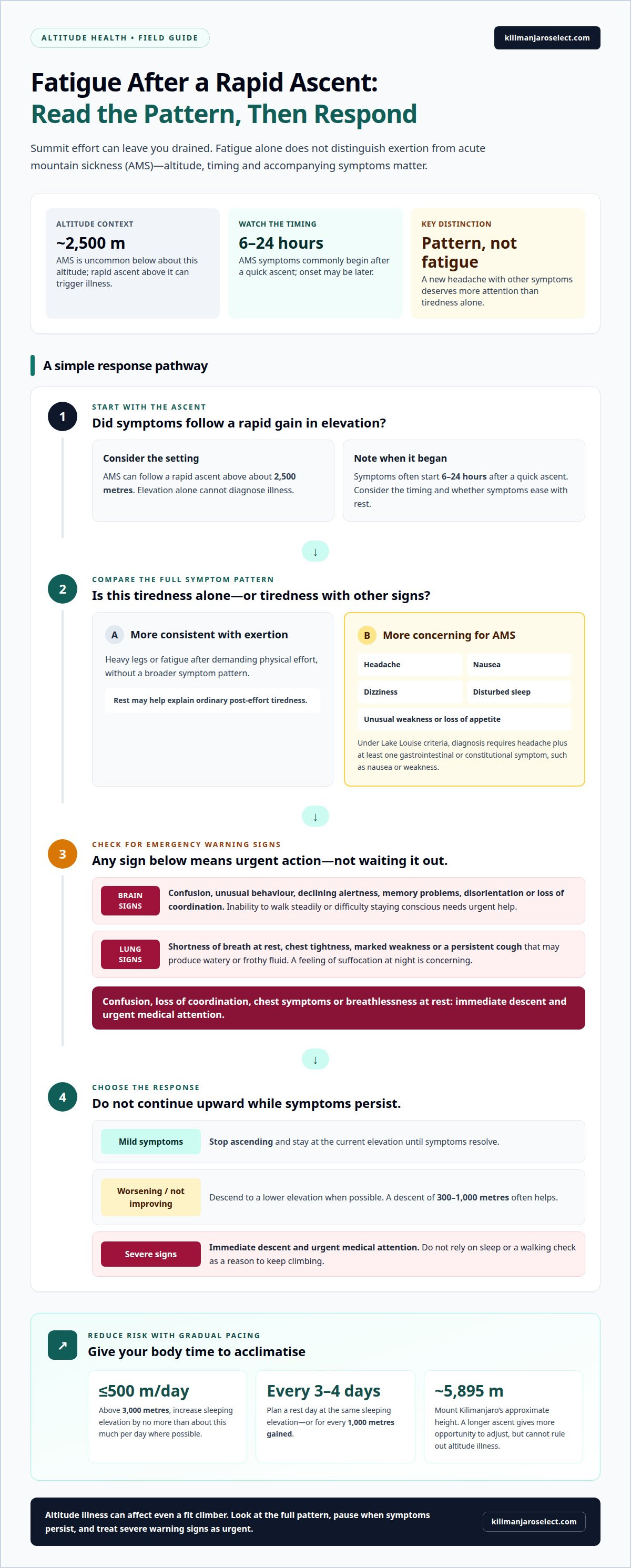
After a rapid ascent, watch for a cluster of symptoms, not fatigue alone. Headache, nausea, dizziness, loss of appetite, disturbed sleep, and unusual weakness can all occur with acute mountain sickness (AMS), often most noticeably on the first night at a new elevation.
The Lake Louise AMS assessment scores headache, gastrointestinal symptoms, fatigue or weakness, and dizziness or lightheadedness from 0 to 3. Under its consensus criteria, diagnosis requires a headache plus at least one gastrointestinal or constitutional symptom, such as nausea or weakness. This pattern helps distinguish illness from summit exertion, but a score should never overrule serious warning signs.
At elevations over 3,000 metres, mild symptoms are common, and they may feel worse at night as breathing changes during sleep. Mild AMS often improves within one to three days when a person rests at the same elevation and stops climbing higher. Reduced urination can accompany AMS, but dehydration can also cause headache, weakness, and nausea, so consider the whole pattern.
- Pause the ascent: Don’t climb higher while symptoms persist. Rest at the same elevation and watch for worsening signs.
- Reduce avoidable strain: Avoid alcohol for the first 48 hours at a new altitude, and avoid heavy exercise during the first 24 to 48 hours.
- Recognize an emergency: Breathlessness at rest, chest symptoms, confusion, or loss of coordination can signal altitude pulmonary edema or altitude cerebral edema. These require urgent medical attention and immediate descent.
Summit-night fatigue after strenuous climbing can be expected, but headache with nausea or dizziness after ascent suggests a different concern. Fitness doesn’t reliably prevent altitude illness, and oxygen shortage affects climbers differently. For a Kilimanjaro itinerary that allows more time for gradual ascent, explore a longer Kilimanjaro trek.
Kilimanjaro Select: 7 Days Machame Route Kilimanjaro Treks
Kilimanjaro Select offers the 7 Days Machame Route Kilimanjaro Trek for climbers planning an ascent with time for gradual acclimatisation. If you’re comparing itineraries after learning how altitude symptoms differ from summit fatigue, consider how the route duration fits your priorities and allows for a measured climb.
The 8 Days Lemosho Route Kilimanjaro Trek is another option, while the 6 Days Marangu Route Kilimanjaro Trek has a shorter schedule. The right choice depends on your preferred route and the time you can set aside. A trek itinerary helps shape the ascent, but symptoms such as headache, nausea, dizziness, or confusion still deserve attention on the mountain.
For a Kilimanjaro trek, contact Kilimanjaro Select to discuss the available route options.
Plan your next climb with care
Understanding acute mountain sickness symptoms versus summit night fatigue can help you make a safer decision on the mountain: pause when symptoms suggest illness, and don’t let summit plans outweigh your wellbeing. Before your trek, consider the route and pace that suit your time, experience, and approach to acclimatisation. A thoughtful plan leaves room to respond to how your body feels as the climb unfolds.
Kilimanjaro Select offers several Kilimanjaro routes, so you can explore an itinerary that fits your plans. If you’re ready to consider your next step, contact Kilimanjaro Select to discuss a trek. Keep your attention on the journey, listen to your body, and let each day on the mountain unfold with care.
Frequently Asked Questions
How is AMS treated?
If symptoms are mild, treatment starts by stopping the ascent and resting at the current elevation. Don’t resume climbing while symptoms continue. If symptoms worsen or fail to improve, descend to a lower elevation and seek medical help. Confusion, poor coordination, chest symptoms, or breathlessness at rest call for immediate descent and urgent medical attention. Keep the affected climber accompanied and describe any changes clearly.
What is the first symptom of getting sick at high altitude?
Headache is a key symptom of acute mountain sickness, but it isn’t the first symptom for everyone. A headache after gaining elevation deserves closer attention if nausea, dizziness, unusual weakness, or poor appetite follows. For example, a climber with a headache after a strenuous day may also be tired, but additional symptoms make altitude illness more concerning than exertion alone.
Who gets AMS?
Anyone can develop AMS after ascending to high altitude without enough acclimatisation. Physical fitness doesn’t reliably protect against it, so strong climbers and experienced trekkers can also become unwell. Ascent pace and sleeping elevation matter more than appearance or stamina alone. A gradual itinerary helps the body adjust, but symptoms still need attention if they arise.
What are the symptoms of acute mountain sickness (AMS)?
AMS symptoms include headache, nausea, dizziness, fatigue or weakness, reduced appetite, disturbed sleep, and general malaise. They can resemble a hangover, although AMS typically occurs without fever or muscle aches. A climber might notice a headache and loss of appetite at camp, then feel dizzy during routine movement. Consider the combination of symptoms and recent elevation gain, not tiredness in isolation.
How can AMS be distinguished from normal summit-night fatigue?
Normal summit-night fatigue follows sustained effort and may feel like heavy legs or low energy. AMS is more concerning when fatigue occurs with headache, nausea, dizziness, or loss of appetite after an ascent. For example, needing a rest after a steep climb differs from feeling unwell while resting, especially when several symptoms appear together. Don’t continue upward if symptoms suggest illness.
When do AMS symptoms typically start after gaining altitude?
AMS symptoms commonly begin within 6 to 24 hours after a quick ascent, though they can start later. That means a climber who feels well on arrival may still develop symptoms overnight or the following day. Track when the ascent happened and when each symptom began. Symptoms starting more than three days after ascent suggest another cause should be considered.


