
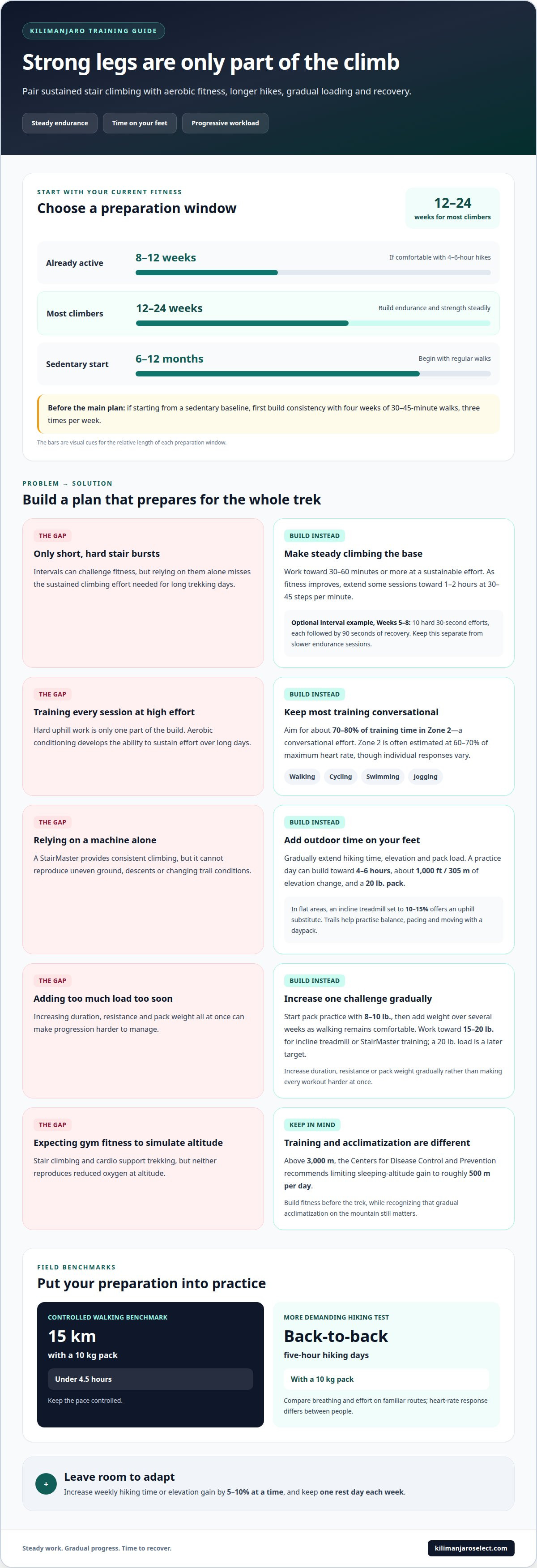
Most people should allow 12-24 weeks before departure to prepare for Kilimanjaro. A stairmaster training program for a Kilimanjaro hike works best as part of that build-up, alongside aerobic conditioning and longer hikes. Already-active hikers comfortable with 4-6-hour hikes may need 8-12 weeks, while people starting from a sedentary baseline may need six to 12 months.
It’s natural to focus on climbing stairs, but preparing for a Kilimanjaro summit takes more than strong legs. You also need steady endurance, practice walking for hours, and a gradual increase in training that leaves room for recovery.
This guide lays out a progressive 12-week approach, with practical ways to combine StairMaster sessions, cardio, strength work, and outdoor hikes. You’ll see how to adjust the starting point to your current fitness, build your workload over time, and arrive in Tanzania with a more dependable foundation for the mountain.
Key Takeaways
- If you're starting from a sedentary baseline, build consistency with four weeks of 30-45-minute walks three times per week before beginning the main plan.
- Use the StairMaster for steady, sustained climbing rather than relying only on short, intense intervals.
- Progressively extend your hikes and elevation gain, and include recovery so your body can adapt to the added training.
- Above 3,000 meters, the Centers for Disease Control and Prevention recommends limiting sleeping-altitude gain to roughly 500 meters per day.
1. How Long Do I Need to Train for Kilimanjaro?
Most climbers should allow 12-24 weeks before departure to build endurance and strength steadily. Already-active hikers comfortable with 4-6-hour hikes may use an 8-12-week training window. People starting from a sedentary baseline may need six to 12 months, beginning with regular walks. Choose your timeline according to your current fitness level and comfort on normal hiking terrain.
A useful StairMaster endurance plan centers on controlled, continuous climbing rather than fast intervals alone. Build toward sessions lasting 30 to 60 minutes or more at a sustainable effort. As fitness improves, extend some sessions toward 1-2 hours at 30-45 steps per minute. A 20 lb. pack can feature in longer, developed workouts, once you can climb steadily without it.
Include StairMaster work among 3 to 5 aerobic training days each week. One sample gym schedule uses a 10-minute low-resistance session Monday and a 10-minute high-resistance session Wednesday. During Weeks 5-8, a stair-interval option is 10 hard 30-second efforts, each followed by 90 seconds of recovery. Keep interval work separate from the slower sessions that build lasting climbing endurance.
Progress by increasing duration, resistance, or pack weight gradually, rather than making every workout harder at once. Start pack practice with 8 to 10 pounds, then add weight over several weeks as your walking remains comfortable. Work toward 15-20 pounds for incline treadmill or StairMaster training; a 20 lb. load is a later target. Carry a weighted daypack on hiking routes, too, so your shoulders and legs adapt to sustained movement over varied terrain.
Stair climbing develops endurance, but it cannot reproduce mountain altitude. For altitude acclimatization above 3,000 meters, the Centers for Disease Control and Prevention recommends limiting sleeping-altitude gain to roughly 500 meters per day. In Tanzania, combine gym stair sessions where accessible with uphill walks on suitable terrain. Choose a route with steady climbing and safe footing, then build hiking time progressively.
2. Aerobic conditioning and stair climbing
Stair climbing strengthens the legs, while aerobic training helps sustain effort over long trekking days. Build your base with steady walking, cycling, swimming, or jogging. These activities develop fitness without making every session a hard uphill effort. Aim to spend about 70-80% of your training time in Zone 2, a conversational effort that supports endurance. Zone 2 is often estimated at 60-70% of maximum heart rate, though individual responses vary.
A stairmaster training program for a Kilimanjaro hike should include sustained climbing, not only short bursts. Keep your steps controlled and your breathing steady, then gradually extend the effort or increase resistance. Pair machine work with outdoor uphill walking when possible. Trails add changing terrain and help you practise a natural trekking rhythm. On flat ground, set an incline treadmill to 10 to 15% for a steady uphill substitute.
Intervals can add variety, but they should complement easier aerobic work. During a build phase, try four hard uphill efforts of four minutes each, with three minutes of easy recovery after every effort. Keep the pace strong but controlled, then return to steady climbing or walking. Use these harder efforts in your StairMaster training program for a Kilimanjaro hike to challenge your fitness without replacing endurance sessions.
Improved aerobic fitness supports sustained work, but it doesn’t remove altitude’s effects. Training references estimate VO₂ max decreases by about 3% for every 1,000 feet above 5,000 feet, and by about 45% at Kilimanjaro’s summit. Gym fitness cannot fully simulate high-altitude trekking. Combine steady aerobic sessions, uphill work, and recovery days, then explore Kilimanjaro trekking routes to understand the mountain journey you’re preparing for.
3. What Kind of Hikes Should I Do to Train?
Choose hikes that gradually extend time on your feet, elevation, and pack load. A solid practice day lasts four to six hours, includes about 1,000 ft/305 m of elevation change, and uses a 20 lb. pack. If you’re new to hiking, start with shorter outings and gentler terrain, then increase one challenge at a time. Steady preparation helps your legs and mental focus adjust to sustained uphill and downhill walking.
A StairMaster gives consistent climbing, while an outdoor trail adds uneven ground, descents, and changing conditions. For Kilimanjaro preparation, use both: the machine builds repeatable uphill effort, and hikes practise balance, pacing, and moving with a daypack. In a flat area, an incline treadmill set to 10 to 15% offers another uphill option. None of these workouts reproduces reduced oxygen at altitude, so strong cardio and leg strength support trekking, but don’t replace gradual acclimatization on the mountain.
Set your timeline around your starting fitness level. Someone currently sedentary may need six to 12 months, while an active hiker comfortable with 4-6-hour outings may use 8-12 weeks. Most climbers can plan for 12-24 weeks, adjusting the workload to current endurance and available training days. A walking benchmark can help: aim to complete 15 km with a 10 kg pack in under 4.5 hours, while keeping your pace controlled.
For a more demanding test, build toward back-to-back five-hour hiking days with a 10 kg pack. Compare your breathing and effort on familiar routes rather than chasing a single heart-rate number; heart-rate response differs between people. Other useful sessions include cycling or swimming for cardio, strength exercises for legs and core, and loaded hikes on varied terrain. Together, these develop the endurance and strength needed for long summit days.
4. Progressive 12-week training plan
This plan builds from regular movement to longer, loaded days, then eases off before departure. Increase weekly hiking time or elevation gain by 5-10% at a time, and keep one rest day each week. If you’re starting from a sedentary baseline, first complete four weeks of 30-45-minute walks three times weekly before beginning this schedule.
Weeks 1-4: Schedule 3-4 aerobic sessions of 30-60 minutes weekly, plus two bodyweight strength sessions. Use an incline treadmill at 8-12% and 4-5 km/h for controlled uphill walking. In Week 3 or 4, add a 2-3-hour hike with 300-500 m of elevation gain. Practise downhill walking carefully, since descents challenge muscles differently from climbing.
Weeks 5-8: Increase to five cardio sessions weekly, with three moderate and two intense efforts. Add a stair session of 30-40 floors, increasing to twice weekly by Week 6. Build one weekend hike to 4-6 hours, 500-800 m of elevation gain, and a 10-12 kg pack. Every 3-4 weeks, make training lighter to support recovery and help your body adapt.
Weeks 9-10: Make the long outing specific to trekking. In Week 10, complete a 5-6-hour hike with at least 800 m of elevation gain and your full pack. Keep the effort controlled; the goal is sustained movement, not a fast finish. Avoid increasing elevation, distance, and pack weight together in one workout.
Weeks 11-12: Peak with 1 or 2 short, fast workouts, then reduce training volume by 40-60% during the final 7 days. In Week 12, use two easy walks of 20-30 minutes and finish hard training at least 4 to 7 days before the summit attempt. This taper preserves freshness; gym exercise builds fitness, but cannot reproduce altitude. Plan your Kilimanjaro trek around a route and schedule that leave room for acclimatization.
Kilimanjaro Select: 7 Days Machame Route Kilimanjaro Treks
Kilimanjaro Select offers the 7 Days Machame Route Kilimanjaro Trek for climbers ready to turn training into a mountain itinerary. Once your weekly hikes and stair sessions are consistent, compare the route duration with the preparation time you have available. The 8 Days Lemosho Route and 6 Days Marangu Route treks offer other itinerary lengths to consider.
Your training builds fitness, but your trek itinerary also shapes how long you spend on the mountain. Review the route options and choose one that fits your travel plans and preferred trek length. Kilimanjaro Select offers guided climbs on the Machame, Lemosho, and Marangu routes. Explore the itineraries at kilimanjaroselect.com to find a trek that suits your plans.
Carry Your Preparation Into the Next Step
Your training plan can help you arrive ready to move with patience, care, and respect for the journey. Build consistency, notice how your body responds to longer days, and choose an itinerary that fits the experience you want. A StairMaster training program for a Kilimanjaro hike can prepare your legs for sustained climbing, while your route shapes the adventure ahead.
Kilimanjaro Select offers treks on the Machame, Lemosho, and Marangu routes. Explore the itineraries and choose the one that fits your plans for a Tanzania climb. A steady training routine can help you prepare for the effort ahead.
Contact Kilimanjaro Select to take the next step toward your Kilimanjaro trek. May each training session bring you closer to the summit with confidence and care.
Frequently Asked Questions
How Long Do I Need to Train for Kilimanjaro?
Most climbers should set aside 12-24 weeks before departure, adjusting the schedule to their current activity level. If you already hike for several hours comfortably, you may need less preparation than someone building a walking habit from scratch. Start with the time you have, then make the first training weeks manageable enough to establish consistency rather than rushing into strenuous sessions.
How fit do you have to be to Climb Kilimanjaro?
You don’t need to be an elite athlete, but you should be able to walk for hours and recover well enough to continue the next day. A useful readiness check is how you feel after a sustained uphill walk and a long descent: notice your breathing, leg fatigue, and whether your pace stays steady. Build strength and endurance around the area that tires first.
Want a Complete Training Plan?
A complete plan should fit your starting fitness, available training days, and departure date. Divide preparation into a base period, a gradual build, harder mountain-specific sessions, and a lighter final stretch. Keep a simple log of walking time, elevation, pack load, and recovery. If fatigue keeps rising or soreness changes how you move, reduce the next session rather than forcing the schedule.
What Kind of Hikes Should I Do to Train?
Choose varied hikes that let you practise steady pacing, uphill effort, and controlled descents. Wear the boots and socks you intend to trek in, and build up their use before travelling; one preparation target is at least 80 km in hiking boots before flying to Tanzania. After each outing, note hot spots, foot soreness, and how your knees feel downhill, then adjust fit or pacing.
What if I Don’t Have Trails to Train On?
You can prepare even without nearby trails. Use a StairMaster or safe stairwell for repeated climbing, then practise descending carefully to condition your legs for downhill sections. An incline treadmill can provide a steady uphill substitute, while step-ups and bodyweight strength exercises add variety at home. Keep sessions controlled, and use ordinary walks to build time on your feet between harder workouts.
How many weeks should you train for climbing Mount Kilimanjaro?
For many climbers, 12-24 weeks is a practical training window; an already-active hiker may use 8-12 weeks, while a sedentary beginner may need six to 12 months. Allow more time if you’re developing a regular walking routine or rebuilding after a break. The key is having enough weeks to increase workload gradually and arrive rested, not squeezing every workout into the final stretch.


