
A guided Kilimanjaro trek in Tanzania takes five to nine days, depending on the route. The climb leads to Uhuru Peak, at 5,895 metres, and the summit attempt is a demanding part of the journey. Choosing your route means balancing the time available with the experience you want on the mountain.
It’s natural to look beyond the summit photo and wonder what each day involves, how the guide and porter team supports the trek, and what the price covers. This guide explains the main route options, what to expect on the Uhuru Peak attempt, and how to compare trek prices and inclusions while keeping comfort, preparation, and the mountain experience in mind.
You’ll find an overview of Marangu, Machame, and Lemosho, followed by practical details about summit day, crew roles, and what shapes a guided climb. Use these details to choose a trek that suits your schedule and priorities.
Key Takeaways
- Compare Marangu, Machame, and Lemosho by trek length and acclimatisation time to find a route that fits your schedule.
- Prepare for Uhuru Peak as the most demanding part of the climb, with a long summit attempt and a substantial descent.
- Understand how guides and porter teams support the trek, and compare crew arrangements and equipment when assessing an operator.
- Look beyond the headline price: review what the trek includes and how route, duration, and group arrangements shape the overall cost.
Which routes can I take on Mt Kilimanjaro?
Your route shapes how long you spend on the mountain, the scenery you see, and the time available to acclimatise. Before choosing a climb to Uhuru Peak, compare the itinerary length with your fitness and the experience you want.
Route Itineraries and Trek Durations
A guided climb to Uhuru Peak and back takes five to nine days, depending on the route. Marangu usually takes five days and four nights, or six days and five nights with an acclimatisation day at Horombo Hut. Machame takes at least six days and five nights, while Lemosho takes seven days and six nights; an eight-day Lemosho itinerary adds an acclimatisation day.
For a nine-day trip, distinguish trek days from the full travel plan. Your arrival and departure times can affect how many hotel nights you need before or after the mountain itinerary.
Scenery, Difficulty, and Summit Success
Marangu’s mountain huts and forest sections create a different experience from routes that use camps. Machame and Lemosho can include an extra acclimatisation night, which can improve the chance of reaching the summit. Umbwe is notably strenuous, with very steep, muddy conditions during its first two days. Compare these practical differences rather than relying on route-specific summit success percentages.
Commonly cited climbing windows include December to early March and June to October; July to October is also considered favourable. Weather and trail conditions vary by season, so use these windows as a guide when planning.
Plan your arrival in Tanzania and onward ground transport to the trek’s starting area. Arrange hotel stays around your trek dates, allowing time to arrive before the route begins and leave after it ends. If your itinerary takes nine days, compare it with your flight schedule, since trek duration and hotel nights are separate parts of the trip.
Uhuru Peak summit attempt
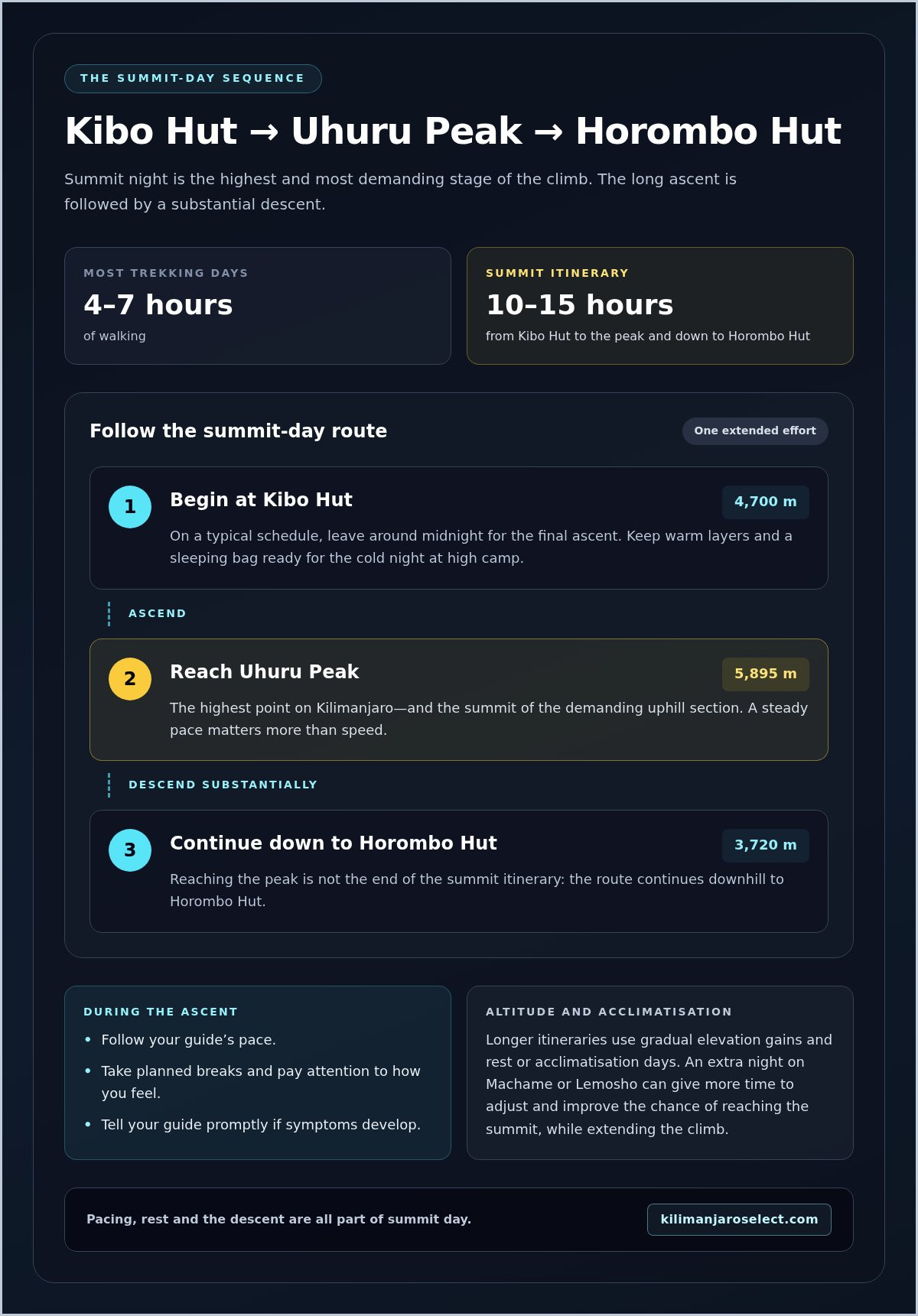
Uhuru Peak rises to 5,895 metres, making summit night the highest and most demanding stage of a Mount Kilimanjaro climb. Most trekking days involve around 4-7 hours of walking, while the summit itinerary can take 10-15 hours from Kibo Hut to Uhuru Peak and down to Horombo Hut. The long ascent and descent make pacing and rest essential parts of the day.
On a typical summit schedule, climbers leave Kibo Hut around midnight and ascend toward the peak. The route climbs from 4,700 metres to 5,895 metres, then descends to Horombo Hut at 3,720 metres. Conditions and each trek itinerary shape the timing, but this sequence means the summit attempt includes a substantial descent after reaching the top. Keep warm layers and a sleeping bag ready for the cold night at high camp.
Altitude affects how your body responds to exertion, so a steady pace matters more than speed. Follow your guide’s pace, take planned breaks, and pay attention to how you feel during the ascent. Tell your guide promptly if symptoms develop. The team can assess your condition and respond to the situation; continuing upward is not the only consideration.
Longer itineraries build in acclimatisation through gradual elevation gains and rest or acclimatisation days. On Machame and Lemosho, an extra night can improve the chance of reaching the summit. This gives you more time to adjust to altitude before summit night, but also extends the climb. Compare the route schedule, not just the total number of days, when weighing summit success.
For a practical decision, review where the itinerary sleeps before the summit and how far it descends afterward. Kibo Hut’s 4,700-metre starting point puts the final ascent in perspective: Uhuru Peak is followed by a descent to 3,720 metres. A climb to the summit is physically demanding, and the daily walking hours build toward this extended final effort.
Guides, porter teams and operator selection
A Mount Kilimanjaro trek relies on coordinated work from guides, porters, and cooks. Group size, luggage arrangements, and safety practices all shape how the team supports your climb.
Group Sizes and Porter Arrangements
Scheduled group treks are limited to ten trekkers. Porter teams carry camping or personal equipment, while trekkers keep their daypack with essentials for walking and changing weather. A porter-carried duffel has a recommended maximum weight of 15 kg; luggage above that may require extra porters.
Before choosing an itinerary, find out whether it is private or scheduled and how the group is organised. These details affect how many people share the guide team and how equipment gets to each overnight stop.
Guide, Porter, and Cook Roles
Guides lead the route, manage the day’s pace, and help the group respond to trail and weather conditions. Porters carry camp equipment and duffels between stops, leaving trekkers to walk with lighter daypacks. Cooks prepare meals and support the team’s daily routine on the mountain.
Accommodation varies by route, so the crew’s packing and transport work does too. On routes with mountain huts, the setup differs from camping routes, where tents and related gear must be moved between camps.
Safety, Ratios, and Porter Welfare
Guide-to-client ratios vary with group size and route. For Lemosho groups of one or two clients, one guide for every two clients is usual; larger groups commonly have around one guide for every three clients. Ask how the team is structured and what safety procedures and emergency equipment support the climb.
Porter welfare matters throughout the trek. Keep each porter-carried duffel within the recommended 15 kg limit, and agree on a group tip that can be shared fairly among the guides, cooks, and porters. There isn’t a single tip figure that fits every group, so base the contribution on the crew and service involved.
When comparing trekking operators in Tanzania, ask about their qualifications and read customer reviews. Clear crew arrangements help you understand who will support your group on the climb to the summit of Africa’s highest mountain.
Guided trek prices and inclusions
Compare a Kilimanjaro quote by route, nights on the mountain, group arrangement, and what the total includes. Marangu uses mountain huts, while Machame is a camping route with mountain tents. These different setups affect the logistics and services required, so comparing headline totals alone can hide important differences.
The price depends on the route, trek length, group arrangement, season, and included services; you’ll receive it after requesting a quote. Look for a clear breakdown of park and permit charges, accommodation, meals, crew, and trek-related transport. Permit and park-fee requirements depend on the climb and itinerary, so compare how these charges appear in the total rather than assuming every quote groups them the same way.
Inclusions matter as much as the route. Check the written itinerary for sleeping arrangements, meals, and whether camping equipment such as mountain tents is included. A sleeping bag may be treated separately from tents, which can affect what you need to prepare. Apply the same careful comparison to transfers and accommodation before or after the trek.
Plan ahead to compare like with like. First, choose a route and itinerary length. Then compare quotes for the same season, group type, and services. If you’re travelling solo, ask about joining a scheduled group, as sharing a trek can reduce the cost. Any discount or seasonal supplement should be shown alongside the relevant dates and terms.
Before choosing, use a simple checklist: route and number of mountain nights; park and permit charges; accommodation and meals; guide and porter arrangements; equipment; and any exclusions. This makes a Machame camping itinerary easier to compare with a Marangu hut trek without mistaking different inclusions for a better value. Request a guided trek quote to compare the route and services that fit your plans.
Kilimanjaro Select: 7 Days Machame Route Kilimanjaro Treks
Kilimanjaro Select offers a 7 Days Machame Route Kilimanjaro Trek for travellers planning a week on the mountain. If you’re comparing routes, its 8 Days Lemosho Route trek and 6 Days Marangu Route trek provide different itinerary lengths to consider alongside your schedule and acclimatisation preferences.
Use the route details in this guide to decide what matters most: trek duration, scenery, camping or hut accommodation, and time for acclimatisation. Then consider which itinerary fits your travel plans and preferred way to experience Kilimanjaro. For a wider Tanzania itinerary, Kilimanjaro Select also offers a 2 Days Safari covering Tarangire and Ngorongoro Crater.
Contact Kilimanjaro Select to discuss the trek that suits your plans.
Choose the climb that fits your plans
Turn your route research into an itinerary that fits the way you want to travel. Consider how much time you can spend on the mountain, whether you prefer camping or mountain huts, and what else you’d like to include in your Tanzania trip. These priorities give your planning a clear starting point.
Kilimanjaro Select offers 7 Days Machame Route Kilimanjaro Treks, 8 Days Lemosho Route Kilimanjaro Treks, and 6 Days Marangu Route Kilimanjaro Treks. Each gives you a different route and trip duration to consider as you plan a guided Kilimanjaro trek in Tanzania. Share your preferred itinerary and travel plans when you get in touch, so the conversation can focus on the climb that suits you.
Contact Kilimanjaro Select to discuss your Kilimanjaro trek plans. Your summit journey can begin with a thoughtful choice and a warm welcome to Tanzania.
Frequently Asked Questions
What to expect on a Kilimanjaro climb?
Expect a steady guided walk across changing terrain, with altitude and weather affecting the pace. On a guided Kilimanjaro trek in Tanzania, follow each day’s briefing, keep essential items in your daypack, and tell your guide if your condition changes. At camp or a hut, use your rest time to prepare for the next stage. Summit day involves a longer effort than a regular trekking day.
How Long Does It Take to Hike Mount Kilimanjaro?
A guided climb to Uhuru Peak and back takes five to nine days, depending on the route. Treat this as time on the trek, not necessarily the full length of your Tanzania holiday. Your travel plan may also need arrival and departure days, plus accommodation before or after the mountain itinerary. Match your flights to the trek schedule rather than assuming the durations are identical.
How do I choose a good Kilimanjaro tour operator?
Choose an operator with clear trekking credentials, crew arrangements, and written itinerary details. In Tanzania, look for a trekking-specific TALA licence, then read customer reviews with attention to their dates and comments about the trek. A detailed itinerary should clearly set out the route, daily stages, and overnight arrangements, so you can compare what each package involves before booking.
How fit do I need to be to climb Kili?
You need enough stamina for repeated uphill and downhill walking, rather than speed or technical climbing skills. Begin training 8-12 weeks before your trek; if you’re inactive or have limited hiking experience, allow 3-6 months. Build regular walking or hiking into your preparation, gradually increasing distance and climbs so your body becomes familiar with sustained effort and uneven ground.
What does a typical day on Mt Kilimanjaro look like?
A typical day has a simple rhythm: prepare for the trail, walk at the group’s pace, take breaks, and reach the next overnight stop. Your guide’s briefing explains the day’s route and conditions. After trekking, organise your personal gear, eat, and rest for the next stage. The summit attempt follows a different, more demanding schedule than a regular walking day.
What happens if I get altitude sickness on Kilimanjaro?
Tell your guide as soon as you feel unwell during the climb. The guide can assess your condition and decide whether the group should pause, change plans, or descend. Don’t hide symptoms to keep the schedule moving; at altitude, your wellbeing takes priority over reaching a particular camp or summit point. Follow the team’s instructions and clearly communicate any change.
